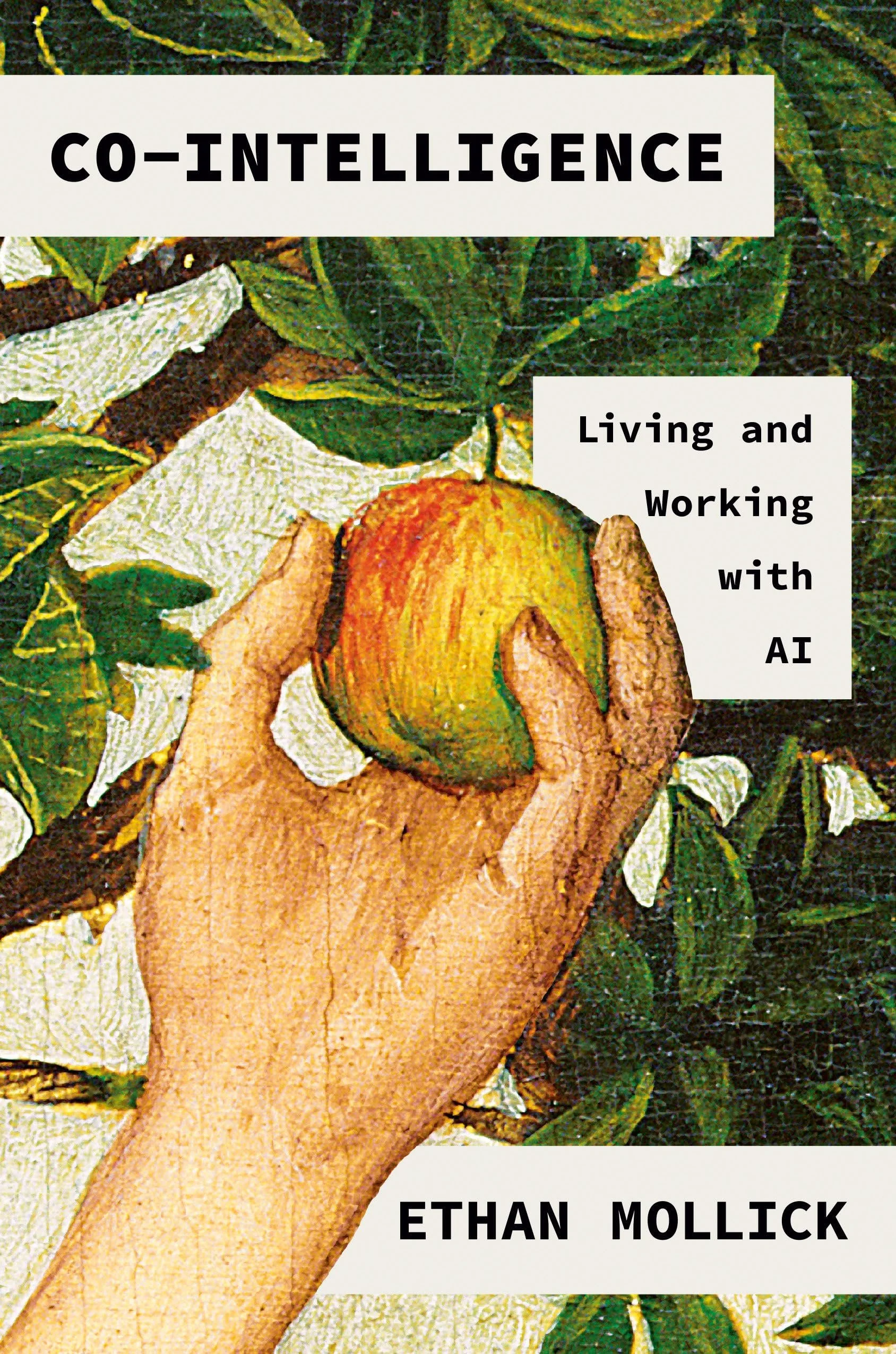
Co-Intelligence
.Rating: 3.5/5
I picked this up because I kept seeing Mollick's name everywhere. His Substack (One Useful Thing) is one of the most popular AI newsletters out there, and the book was a New York Times bestseller. I figured if anyone could give me a clear framework for thinking about AI at work, it would be a Wharton professor who actually uses these tools every day.
And he does. Mollick isn't writing from the sidelines. He's someone who uses ChatGPT in his classroom, runs experiments with his students, and tests AI tools on real tasks. That comes through in the book. It feels practical, not theoretical.
The core idea is that AI should be treated as a co-intelligence, not a replacement for human thinking but a partner in it. He breaks this down into roles: AI as co-worker, co-teacher, coach. He introduces this concept of "centaurs" (people who clearly divide tasks between themselves and AI) and "cyborgs" (people who blend their work with AI so tightly you can't tell where one ends and the other begins). That framing helped me think more clearly about how I already use AI in my own marketing work.
Here's the thing though. If you've been actively using AI tools for a while and reading about them regularly, a lot of what Mollick covers will feel familiar. I found myself nodding along more than I found myself learning something new. The book validated the way I was already working with AI, which was reassuring, but it didn't blow my mind.
That's not really a criticism. For someone just getting started with AI, this book would be a perfect first read. It's clear, it's sensible, and it doesn't fall into the trap of either hyping AI up or treating it like a threat. Mollick stays grounded throughout.
Where it fell a bit short for me was depth. I wanted him to go deeper into specific industries, specific use cases, specific failures. The book stays fairly high-level, and given how fast AI is moving, parts of it already feel slightly dated.
Still, I'm glad I read it. It gave structure to a lot of things I was doing instinctively and gave me better language to talk about how I work with AI. If you're early in your AI journey, start here. If you're already deep in it, you'll still find it useful, just don't expect to be surprised.